Friday, May 24, 2013

Recipes for Success


Tooting my own horn a bit this morning by sharing the lovely comments Anita Osterhaug made preceding a post I wrote for Weaving Today, the online resource for Handwoven magazine. Anita is the editor of Handwoven. Her continued enthusiasm and support are hugely appreciated!


.
May 24, 2013
Recipes for Success

Sarah Jackson is one of the most talented weavers and designers I know. I am perpetually in awe of her ability to marry structure, yarn, and color and produce just the right fabric for her purpose. Sarah blazes new territory in her weaving, but she also appreciates the value of having a path to follow. ––Anita


When I decided to resume weaving several years ago after a long hiatus, I wasn't sure I could remember how to dress my loom, much less figure out the specifics of a new project.

So for my first foray back into the world of weaving, I opted for a project from a book I found in the library, Handwoven's Design Collection 20, Weekend Weaving Projects. Wanting to focus strictly on the mechanics of weaving, I chose to use the exact yarn and colors specified and followed the instructions to the letter. The venture took decidedly more time than one weekend, but the result was two lovely tea towels . . . and renewed confidence in my weaving ability.

A year or so later, after joining my local weaving guild, I heard a member scoff, "Real weavers only need more technical information, not recipes for weaving," Well, I have to say, I'm all for recipes (and I'm a real weaver). Following "a recipe" for a weaving project allows one to learn a new technique or experience an unfamiliar fiber, color combination, or weave structure without the concerns of designing from scratch.


Case in point: a new weaver in my guild approached me recently to excitedly tell me she had just finished weaving cloth for a project of mine in the November/December 2012 Handwoven. "Squares within Squares Top" is an 8-shaft turned Atwater-Bronson lace project with a complex treadling sequence.

Quite an ambitious project for a beginning weaver, or so I thought! She had tackled it with confidence knowing all the details and information were at hand. Along the way she became familiar with a new weave structure, learned to treadle with both feet simultaneously, wove with Tencel for the first time, and discovered a new wet-finishing technique.

As a designer, I'm thrilled when others are inspired by my work. If their confidence and competence as weavers increases as a result of recreating one of my projects, then the joy of doing what I do is magnified as well. I'm going to write more recipes!

—Sarah H. Jackson


Sarah Jackson's Squares WithinSquares Top. The "recipe" can be found in the November/December2012 issue of Handwoven

Spacer 15x15 pixels 

 
.

Wednesday, May 8, 2013

Spinning Straw into Gold ...

Rumpelstiltskin is the name of the antagonist in a Grimm's fairy tale who tricks a miller's daughter into trading her first-born child for a room full of straw he spins into gold for a greedy king. 

I didn't spin straw into gold, but this warp seemed to hold some fairy tale magic, and I felt a bit like Rumpelstiltskin ...weaving, rather than spinning, this combination of yarn into a shimmery copper blend. Below is a shot of the warp (rayon boucle and 20/2 cotton) over the back beam:
The weave structure is diversified plain weave from A Weaver's Book of 8-Shaft Patterns, page 170, a variation of the treadling in the upper left corner.
The weft is rayon chenille and 20/2 cotton. Hard to see here, but if you squint a bit, you can see the square motifs:
While Strickler's book states, "The structural threading and treadling units cannot be enlarged", that is true only if one uses the threading sequence provided which alternates the tie-down threads for each block on odd and even shafts. In other words, the tie-down threads being 1 and 2, Block A is threaded 2 -3-2, Block B is threaded 1-4-1, Block C is threaded 2-5-2, and so on. If threaded in this manner, it should be obvious that threading two of the same block sequentially is problematic. For example, two A Blocks would be threaded 2-3-2, 2-3-2 which places two ends on shaft 2 one next to the other. In order for the tie-down threads to work, they must alternate on shafts 1 and 2.

A solution for enlarging the units can be found in "Thick and Thin" by Interweave Press which explains the "new" diversified plain weave. This method alternates the tie-down threads on shafts 1 and 2, but each block uses one of each. Block A is threaded 1-3-2, Block B is threaded 1-4-2, Block C is threaded 1-5-2, and so on. For example, two A Blocks would be threaded 1-3-2, 1-3-2. Using this threading system it's possible to expand the threading and treadling units without limitation. Sampling provided me with the information I needed to determine the desired size of the unit I chose as well as the final combination of yarn and colors. 

In my next post I'll show some of the samples and talk about the metallic foil I used to embellish the finished garment.

Thursday, February 7, 2013

Atwater-Bronson Beaded Top

Looking over my most recent posts I noticed I hadn't shared the results of fabric I was working on ...last May! I was surprised to remember that I started it that long ago, and it makes me realize how long the designing, weaving, and finishing process often is. I finished the weaving in June and put the top together then. I took it with me when I attended Convergence in July, but found little time to work on the embroidery and beading then. It was finished and mailed to Handwoven magazine in mid-August for publication in the November/December issue. The description, "Sarah Jackson's snowy, showy Atwater-Bronson top..." really does describe the look of the fabric, although the beads and silky embroidery floss catch the light and shimmer more noticeably than the photo shows.
In the close-up below you can see more clearly the two threads I used--8/2 cotton which has a matte finish and tencel which is shiny--in both the warp and weft. The embroidery and bead placement was mapped out with pieces of freezer paper  ironed onto the fabric.
It was fun wearing the top around the holidays for a bit of sparkle and shine!


Monday, December 31, 2012

Thoughts for a New Year

As editor of my weaving guild's newsletter, I write a letter every month to our members. Several members have suggested I share January's letter here. For those of you who are not weavers or spinners, remember that you 'make music' in your own special way.

Dear Weavers and Spinners,

"It was a year of storms, of raging winds and rising water, but also broader turbulence that strained our moorings." So read Wednesday's paper in an article recapping the top ten news stories of 2012. Most recent, and certainly most raw, is the incomprehensible horror in Connecticut that shattered our hearts earlier this month. Two weeks later officials in Newtown have asked people to stop sending gifts to the town, saying they're deeply grateful but unable to process the overwhelming volume of items.

I understand the response of those who have sent something to the residents of Newtown, and I'm heartened by their care and concern. In the face of immeasurable tragedy, our hearts aching, our minds straining for answers to the unfathomable, we feel helpless to turn the tide of grief that we know threatens to overwhelm those directly involved. How can we help? Is there anything we can do that will truly matter? Our love and our prayers are meaningful, enduring gifts, and yet, we long for tangible offerings.

One answer, an antidote for our sorrow and sense of helplessness, came in the days following the shooting. Someone posted, on Facebook, this quote by American composer and conductor Leonard Bernstein, champion of peace and humanity; “Let this be our reaction to violence — to make music more intensely, more beautifully and more devotedly than ever before.”  As that concept resonated within me, I realized that, as weavers and spinners, our looms and wheels are our instruments; we make music with thread. The harmonies, the melodies, and compositions we weave and spin are joy to create and share with our families, our friends, and our community. Let us resolve to tip the balance between despair and hope by "intensely and devotedly" making handwoven music …and sharing it with our world.

May you find peace in creating. May your creations be songs of love. May your special music uplift and encourage those you share it with. And, as you ply your craft, "…whatever is true, whatever is noble, whatever is right, whatever is pure, whatever is lovely, whatever is admirable—if anything is excellent or praiseworthy—think about such things."

Warmly,
Sarah H. Jackson, editor

Thursday, December 13, 2012

Dogwood Lace Tunic

Finished! The label is sewn in and it's ready to wear. Well, actually... ...ready to wrap and mail to Handwoven. The wearing will have to wait. 
Someone in the publishing business once told me that greens and blues are the most difficult colors to photograph accurately. I believe it! The true color is somewhere between these first two.

Making the Chinese ball buttons and frog closures was an experience in itself! Definitely a challenging project, but I'm happy with the final result.


Tuesday, December 11, 2012

Dogwood Lace Tunic

I've been working for several weeks on a lace project using Silk City's Bambu 12 from Cotton Clouds; sett at 30 ends per inch and woven at 30 picks per inch, 36" in the reed. Definitely not a quick project, ...but interesting to weave and satisfying to watch develop on the loom. I love the finished fabric; it looks and feels remarkably like silk.
The color is a soft, muted green, most accurately seen in the photo below:
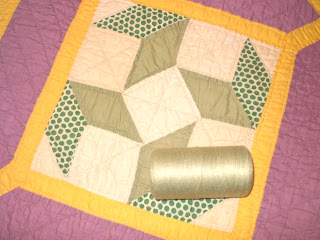
This project is for the March/April issue of Handwoven magazine featuring designs that recreate or are inspired by heirloom linens. My inspirations were a vintage lace bodice from Paris and a 1930's quilt; each tells a story of one of my grandmothers  ...but I'm saving that for the magazine.
An Oriental-style tunic, Vogue 8830, seemed a good fit for the fabric. I shortened the sleeves to 3/4 length, omitted the cuff, and lined it with a printed rayon. The final stitches will go in tomorrow. Yea!
(photos of the finished tunic in my next post)


Thursday, November 15, 2012

http://gallery.mailchimp.com/8f0ab6b10e217429dbb9dbb1d/images/image_13468247465131346824748.jpg 


A Sneak Peak For You!

At just a few of the many handwoven creations you'll find at our Annual Exhibit & Holiday Sale!

Sarah Jackson, Crackle Purse

Purses by Sarah H. Jackson

Deb Shoenberger, Slot Canyon Tapestry
Slot Canyon, Tapestry by Deb Shoenberger

Mary Saxton, Jacket
Jacket by Mary Saxton

Designing Weavers
Annual Exhibit & Holiday Sale


Saturday, November 17 &
Sunday, November 18


10am to 4pm each day
AT OUR NEW LOCATION!
Women's Club of Sierra Madre
550 W. Sierra Madre Blvd., Sierra Madre, CA

Click here for a map
  

Celebrate the Season with Fiber!

You'll find unique, handmade gifts:
Wearables, Basketry, Jewelry, Scarves, Rugs, Hats,
Sculpture, Tapestry and More!


DesigningWeavers.com