Saturday, January 22, 2011

Knitting Daily Weaves in the New Year!

Knitting Daily, an online community for knitters and other fiber lovers,  invited Pattie Graver, managing editor of Handwoven magazine, to discuss the new issue of Handwoven, and she mentioned my vest.  

"For example, inspired by a Hindu toran (a toran is a decorative door hanging), Sarah Jackson wove a stunning vest."  

Thanks, Pattie!  

You can read the article by pasting the following address into your browser: 

http://e1.interweave.com/dm?id=47D7867A97C4C166C7E1CD895612BDD6AD0B43E0AE847CC5

http://www.knittingdaily.com/cfs-filesystemfile.ashx/__key/CommunityServer.Components.ImageFileViewer/CommunityServer.Blogs.Components.WeblogFiles.daily/6153.pg-42_2D00_JACKSON_2C00_-Hindu-toran-vest.jpg_2D00_550x0.jpg

Tuesday, January 18, 2011

Toran Inspired Handwoven Vest

When I looked at the date of my last post, I was surprised how long it's been!  The most exciting  news I have to share is the publication in Handwoven magazine of a vest I designed.   Each issue of Handwoven typically revolves around a central theme, and this issue (Jan/Feb 2011) focuses on weaving inspired by other cultures.  The Museum of International Folk Art in Santa Fe houses an incredible textile collection, and that's where I found my inspiration for this vest.  A toran, a Hindu door decoration, sparked the idea for the shaped tabs and beads at the hemline.  I don't have permission to print the photo of the toran here, but it may be seen by pasting this link into your browser:

http://books.google.com/books?id=F9FYlRfSMj0C&pg=PA52&lpg=PA52&dq=collection+museum+international+folk+art+door+decoration+India&source=bl&ots=5slXCmWTyp&sig=ZrsfMXDRV5-aNH7itLV66rD8uVQ&hl=en&ei=RempTPDrIY-2sAOEv_HvDA&sa=X&oi=book_result&ct=result&resnum=1&ved=0CBIQ6AEwAA#v=onepage&q&f=false


                This page from Handwoven is published with permission from Handwoven magazine. 
http://eimages.interweave.com/products/240/H1101.jpg
If you are interested in a copy, it is available here:  http://www.interweavestore.com/Weaving/Handwoven-Magazine/Handwoven-January-February-2011.html

This is the intro I wrote for my article:

The idea for this vest began to take shape when I read about Handwoven's theme issue featuring weaving based on other cultures, and a trip to New Mexico revealed the elements that eventually came together for the final design.  A Taos weaving friend gave me a partial cone of space dyed rayon chenille, and when I saw Bonnie Tarses' "Almost Ikat" technique at Convergence in Albuquerque I knew the yarn and technique were a good match.  I wanted fringe on one edge of the vest but because chenille is unsuitable for fringe I wondered how it could be finished in a unique way.   I found the answer in the textile collection of the Museum of International Folk Art in Santa Fe; a door decoration from India that suggested woven tabs with twisted fringe in between.  Later, during a visit to a bead shop near Taos I discovered the Bali style cone beads whose shape mimics the tasseled ends of the door decoration fringe and sparked the idea for adding beads to the vest.   Serendipity in New Mexico?  I think so.  


Thursday, December 9, 2010

Indigo Dyeing, Finishing Up

The yarn I dyed Tuesday is not quite dry, but I thought you might like to see a few things that are finished.
Silk Camisole


The lower edge was tied with sewing thread over black beans.  The upper area was pleated and clipped with clothespins. 

 Woven shibori scarf.  Cotton warp, rayon chenille weft.  


Arashi (pole-wrapped) Shibori, silk crepe de chine scarf.


Silk charmeuse scarf, dyed first, pleated and folded, then clamped between two canning jar lid inserts. 


The indigo dyeing process involved a full day of prep work and another day to complete the dyeing, rinsing, and removal of resist threads, etc.  Lots of work, but well worth the effort! 

Tuesday, December 7, 2010

Indigo Dyeing

I spent most of today with my good friend, Susan, and her sister, Kathy, who is visiting from Japan.  We dyed a variety of things using an indigo dye kit.  It was a perfect day to be outside in Susan's beautiful back yard.  I took several pictures of things as they came out of the dye pot; here is a silk scarf with marbles tied in:

This is an experiment in Arashi shibori, also known as pole-wrapped shibori.  The fabric (in this case, a silk scarf) is wrapped around a length of pvc pipe, secured with cotton yarn, and then immersed in the dye bath.
 
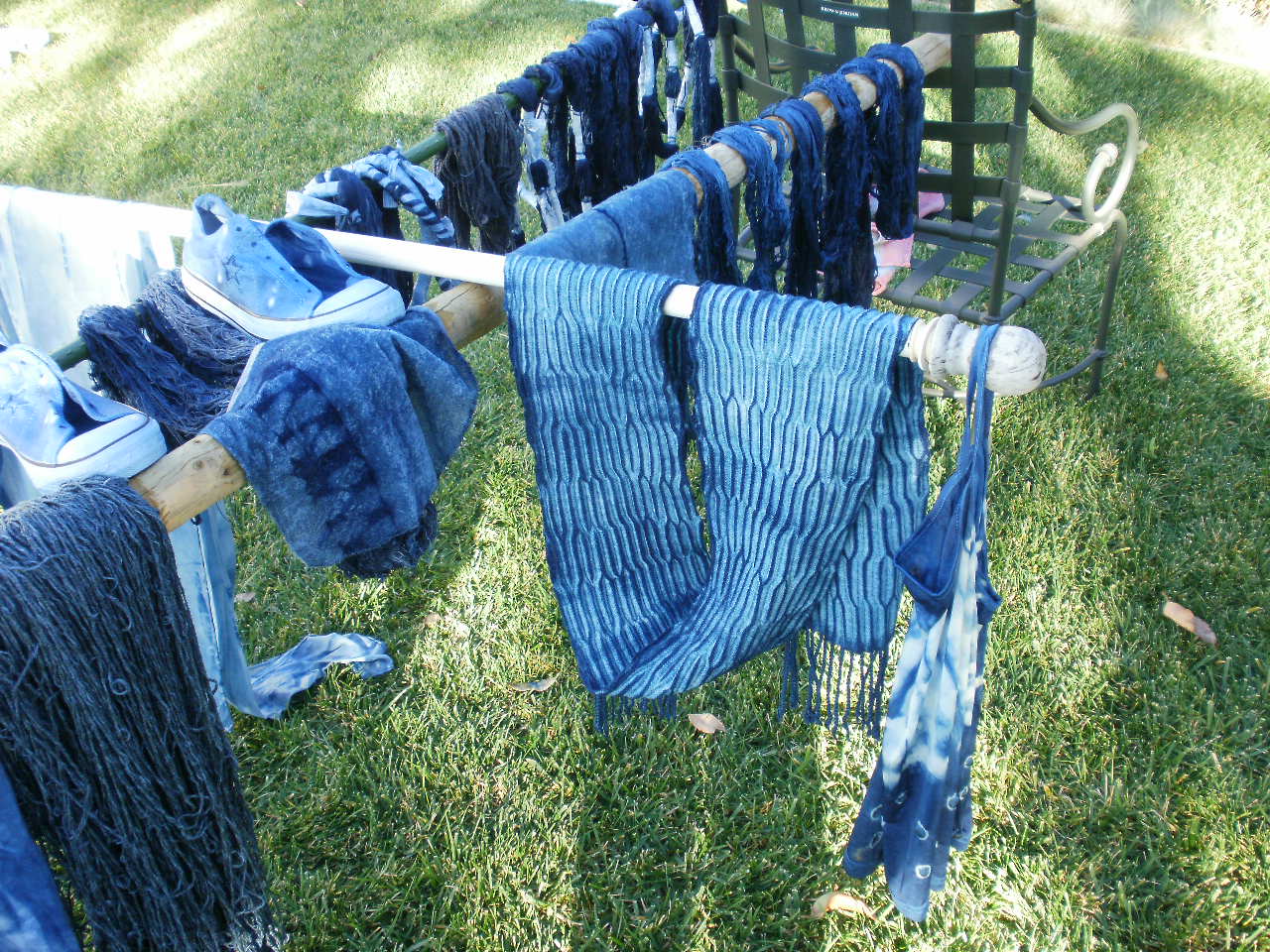
Susan set up a system of drying racks, here draped with skeins of yarn, silk scarves, Susan's tennies, etc.

Below is a close-up of Susan's Indigo Converse All-stars! 


The scarf on the left was folded, clamped, and overdyed.  The one on the right is the final result of pole-wrapping.
  
More scarves, various resist techniques:


 Some of our results after removing wrappings, bindings, clips, etc:

What a great day!  Fun to be with friends and experience something new!  Plus, we took a break and had a delicious lunch at Zena's in Orange, an excellent Lebanese restaurant.  

After coming home I rinsed my scarves and yarn and hung them to dry.  Can't wait until tomorrow to see the final results!  


Friday, December 3, 2010

Sari Silk Vest, Part 4

Finally!  I finished stitching the shisha mirrors and fabric squares to my vest, placing them at random on the fronts and the back.

The next step is to cut the lining and make the binding.  For the lining, I may incorporate some of the sari fabric scraps.  I like to make the inside of a garment interesting as well.  For the bias binding I found the perfect color silk; a shade of wine that is just the right accent. 

Following directions in the book, Happy Endings - Finishing the Edges of Your Quilt,  by Mimi Dietrich, I'm going to make continuous cut bias binding.  I've had the book for many years, and it's been a great resource; well illustrated and clearly written instructions.  Bias binding works well in many finishing situations and has a stretch that allows it to turn smoothly around curves, miter edges, and lie perfectly flat along a straight edge.  The method of continuous cut binding allows one to make one long strip of binding by sewing only two seams.  Much easier and more accurate than sewing a lot of separate strips together!


Tuesday, November 23, 2010

Sari Silk Vest, Part 3

I've decided to do some embellishing on my vest, and since the accent yarn is made of recycled silk saris, it seems appropriate to use an embellishment technique often found on Indian garments.  I purchased sari scraps from tweedylane a vendor on Etsy.  I wasn't sure exactly what I would get, but I was pleasantly surprised to find a mix of colors that will work perfectly with my fabric.

The embellishment technique for Buttonhole Cup Method of attaching shisha mirrors is one I learned in a workshop with Anita Luvera Mayer
Here you see some of the mirrors attached to squares of the sari silk.

I'm attaching the mirrors first, and will later decide exactly what shape and size to cut the background.  Next step is to cut the vest fabric and sew it together so I can determine exactly where I want the mirrors.  

Off to the cutting board!

Friday, November 19, 2010

Sari Silk Vest, Part 2

I finished weaving the fabric for my vest a couple of days ago.  This is how it looked immediately after being removed from the loom; The weave looked coarse and had the feel of  light burlap.  Not what you want in a handwoven fabric intended for clothing!  But, because I had used the same yarn before, I knew the washing and finishing would result in a very different fabric. 
 
 After removing it from the loom I hand washed it, experiencing several minutes of near panic as I watched the water turn deep purple and the fabric turn very reddish.  I hadn't tested the sari silk yarn to see if it was colorfast.  Fortunately, I was using synthrapol (soap specifically formulated for textiles to prevent migration of any dye released during washing), and, after several rinses, the colors returned to their original state.
Above is the fabric after it has been dried and pressed.

And a close up showing how the fabric changes with finishing.  The cotton in one of the yarns "blooms" and shrinks, drawing the threads of both warp and weft together and creating a soft, drapeable fabric.

Once again, a good reminder that when you weave; sample and test everything!