Saturday, August 25, 2012

8-Shaft Turned Bronson

This morning I finished a sample of 8-shaft Turned Bronson using a new yarn from Webs; Colrain Lace, a 50/50 blend of merino wool and tencel. The yarn is gorgeous; soft with a slight sheen and lovely drape that make it perfectly suitable for clothing. Here is the sample on the loom:
Bronson, like most handwoven lace, looks very different on the loom compared to what it looks like after washing and finishing. It's often difficult to tell exactly what's happening with the lace while weaving, but the use of two colors in this piece make it easier to see. When taken off the loom, it relaxes somewhat. Here you can see the weft (darker blue) and warp (light teal) floats:
Notice how square the spaces are between the lace motifs? Magic happens when the fabric is washed; the ends in the lace areas shift and collapse creating a very different fabric:
Look how dramatically those square areas shifted, creating the illusion of circles. I love that! Weaving tends to be very "square" by nature, so I think it's exciting to see such a dramatic difference in the final appearance of the cloth.
I wove samples with two different colors of weft; the dark blue in the previous photos and a darker teal seen here on the right:
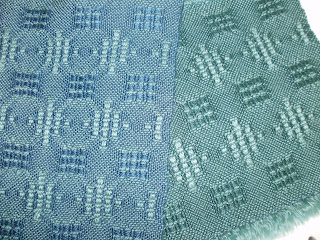
It's interesting to see how the weft color impacts the perceived warp color: with the blue weft, it looks more blue; with the dark teal color, it appears more green. I like both of these, but especially the sample woven with blue, so that's probably what I'll use for the garment I'm planning. A vest? A jacket? I have to decide so I can get back to weaving!


Monday, July 23, 2012

HGA Award for Weaving

I couldn't be more excited! Handweavers Guild of America (HGA) held their biennial international Convergence conference this past week in Long Beach, California. The winners of all the exhibits were announced at the close of the "Pacific Currents" Fashion Show Wednesday night, and I almost fell off my chair when my name was announced as the winner of the HGA award!

I was thrilled when my entry was juried into the "Longitudes" yardage exhibit several months ago, and it was exciting to see it as part of the display in the lobby of the convention center. Winning the HGA award is more than I ever imagined. 

From HGA's website:

The HGA Award honors outstanding exhibited works. It is a prestigious award and may be presented only to work which clearly demonstrates excellence.

The HGA Award includes a certificate of accomplishment and a handwoven ribbon. Award winners receive further acclaim through publication in Shuttle Spindle & Dyepot, HGA’s quarterly award-winning magazine, and an opportunity to have their work appreciated by an international readership of fiber artists, enthusiasts, and collectors.

Award Criteria
  • Must embody a unique interpretation; demonstrate a fresh, individual approach, and express personal creativity.
  • Must exemplify a complete understanding of both aesthetic and functional considerations.
  • Must demonstrate excellence in technical skills. 

I am honored beyond words.
The upper level of the lobby allowed access to the 8 x 8" touch panels that were required for each piece. These allow viewers the chance to examine the fabrics closely.  The panels also include information about materials used, weave structure, etc.
Guess whose panel this weaver is looking at! 

I had a wonderful, fun, inspiring week made more special by the many weavers and fiber people I met from all over the world. I can't wait for 2014!


Note: If you would like to read the post I wrote just after weaving the fabric, you'll find it here: Summer and Winter in Bambu 7


Thursday, May 24, 2012

An Atypical Transparency

The May/June 2012 issue of Handwoven magazine arrived last week with my article about using the technique of handwoven transparency in the design of a garment. It's always interesting to see how the photo stylist presents my work, and I like the absence of a model for this photo which allows the transparent quality of the weaving to be seen more clearly.
 Photo by Handwoven magazine
The inset photos are some I took during the weaving process that accompany my instructions for weaving the inlayed squares. 

According to Editor Anita Osterhaug, the editorial team was disappointed that the final photo didn't clearly show the true colors of the inlays, but you can see them here in the detail photos; luminous gold, a little pewter, and earthy shades set off by the taupe background.

And now that the blouse is back home, I can finally wear it!

Friday, May 18, 2012

Atwater Bronson Lace Sample and Fabric

My Weave Structures Study Group has been focused on various lace weaves this year, and I recently discovered a draft for "Concentric Squares" by Dorothy S. Burton in Carol Strickler's 8-Shaft Pattern book. 

I thought it would be interesting to see if the squares could be woven in different combinations and/or with some solid, some open areas. After a lot of experimenting with a computer drafting program, I wove a sample-- a portion shown here:

While I have several ideas for using the squares-in-squares possibilities, I also worked out a way to weave open and closed squares across the width of the cloth. That fabric is now on my loom:
The limitation with this particular combination is that, in addition to the shafts for tabby (2), each square requires two more shafts; so eight shafts can weave three different squares. I used three of each square for a total of nine across the fabric, alternating weaving them solid or open.


The fiber is white tencel and natural 8/2 cotton woven with the warp floats on the surface. But... I think I'll use the reverse side of the fabric for the right side. I like the look of the weft floats, and, on that side, the pure white tencel creates a tiny bead-like spot between the lace squares which will look great with the beading I plan to do on the finished garment. 


Now, back to my loom!


Friday, April 13, 2012

Diversified Plain Weave Vest, Plan C

While I was eventually able to straighten out my tangled chenille warp and weave it, the resulting fabric was not what I'd hoped for. So, on to Plan B: I warped my loom again; different yarn, different colors, but after weaving four or five inches, my reaction was (as Snoopy would say), "Bleh!" It looked like mud. I cut that warp off and moved on to Plan C. Again, different colors, different yarn, but this time the result was just what I was looking for.
I love this weave structure-- a variation of diversified plain weave-- the same I used for the black and natural tote bag I wove a couple months ago, and it's fascinating to see how the yarns used impact the finished fabric. The tote bag fabric is woven of 8/4 cotton rug warp and produced a sturdy, durable cloth while the vest fabric yarns--primarily rayon-- resulted in a soft, silky, lustrous fabric.
Diversified plain weave is difficult to visualize when reading an explanation of how the threads interact, so I took some photos that, I hope, will make sense. Notice how the balance of colors raised in each shed shifts from less to more of the gold, allowing more or less of the rose-colored weft to show on the surface. The colors appear in opposite positions on the reverse of the fabric.


In the photo below, the colors are more accurate (not sure why I was getting such strong red and orange in the ones above).
And, finally, the finished vest!
Now...off to the loom to sample for my next project!

Monday, April 2, 2012

Elemental Huck-Lace Top, Etc.

The huck-lace top I designed for the most recent issue of Handwoven magazine is now available as a kit from Cotton Clouds, and owner Irene Schmoller has asked me to share a little more about the weaving and construction process here.
http://www.cottonclouds.com/database/textfiles_cotton_clouds/rotationHome/photo_97.jpg
Photo from Cotton Clouds website

The design for the top was inspired by a challenge in my Clothing study group to create a garment made of strips, the huck-lace my weave structures study group was exploring, and my interest in using Bambu 7 (100% bamboo) for the first time. I chose four colors of Bambu 7 and a coordinating Luna ribbon.
I wove a sample using all four colors...
but decided to use only two for the top; Walnut for the warp and Water Chestnut for weft.
Below is the photo I submitted to Handwoven for their consideration. Please note that the top is unfinished; the hem is only pinned in place, so it looks a little strange at the hem. I finished it before sending it to Handwoven, of course!
Back view:
 And a close-up of the back:
I love the way this top turned out; it feels silky and soft, drapes beautifully, and is loaded with textural interest. I wish the photo in Handwoven showed more of the fringe on the one front panel; it adds another element of texture. 

The Handwoven article includes three process photos I took that provide good visual instruction for joining the woven panels with ribbon. If you are weaving the top and have any questions, please feel free to contact me. And... please! send me a photo of your finished top. I would love to see it.

Saturday, March 24, 2012

Elemental Huck-Lace Top

The latest issue of Handwoven magazine finally arrived in my mailbox yesterday. The March/April issue is the first solo effort for Handwoven's new editor-in-chief, Anita Osterhaug, and she did a fabulous job! I'm excited for this issue for three additional reasons: First, it includes one of my designs...
 
Photo by  Handwoven


First page showing the back of the top
Second, an article I wrote after sampling some new yarn from Habu Textiles...

Page 1 of  2
And, third, it is the first issue I worked on as a technical editor!
I learned a lot, thoroughly enjoyed working with the editorial team, and have a new-found, huge appreciation for what goes on behind the scenes to pull an issue together successfully. We're finishing up the initial tech edits this week for the May/June issue...it's going to be another good one!